
Satyanarayan Katha — 5 Adhyay in Story Form
Every Satyanarayan Puja has a moment when the room goes quiet. The aarti is done, the flowers have been offered, and then the pandit opens the katha. What follows is not just a recitation — it is the reason the puja exists.
The Satyanarayan Katha is the heart of the entire ritual. It is made up of five short chapters — called adhyays — each telling a different story about what happens when people keep this vrat with sincerity, and what happens when they don’t. Together, they answer the questions every devotee quietly carries into the puja: Why does this matter? What am I really asking for? And what is expected of me in return?
This page tells all five chapters in plain English, with the moral from each one, so you can follow along during the puja or understand the katha before you host one.
The Setting — How the Katha Came to Be
The katha is drawn from the Reva Khanda of the Skanda Purana, one of the eighteen Mahapuranas. It is narrated by Suta Puranik to a group of sages gathered in the forest of Naimisharanya — a setting that itself carries meaning. These are people who have left the noise of ordinary life to ask deeper questions. The question at the centre of this gathering is one that feels as relevant today as it did then.
The sage Narada Muni, who travels freely between the mortal world and the celestial realms, had descended to earth and seen suffering everywhere. The age of Kali Yuga had set in — an age of confusion, broken relationships, and people struggling to find their footing. Narada, deeply moved, went to Lord Vishnu and asked a direct question: Is there a single practice — simple enough for any ordinary person — that can bring relief from suffering and lead people toward peace and prosperity?
Vishnu did not give a complicated answer. He told Narada about the Satyanarayan Vrat — a puja so accessible that anyone could perform it, regardless of wealth, status, or learning. What it required was not elaborate preparation. It required sincerity, a vow, and the willingness to honour that vow once fulfilled. This conversation between Narada and Vishnu forms the opening of the katha, and sets up everything that follows.
Adhyay 1 — The Origin of the Vrat
Vishnu explains the Satyanarayan Vrat to Narada in detail — how it should be performed, what items are needed, what prayers should be offered, and why this particular form of worship is so powerful in Kali Yuga.
To show Narada that this is not merely theory, Vishnu points to a poor Brahmin living in the city of Kashi. This man has almost nothing — no savings, no security, no certainty about where his next meal will come from. Every day he wanders the streets hoping to find enough to feed his family.
One morning, Lord Vishnu himself appears before the Brahmin, disguised as an elderly man. He asks the Brahmin why he looks so troubled. The Brahmin answers honestly — poverty, helplessness, not knowing what to do. The old man listens and tells him about the Satyanarayan Vrat. He explains it simply: gather what you can, perform the puja with sincerity, and offer the katha with full attention. The Brahmin, who has nothing to lose and nowhere else to turn, decides to try.
That night he dreams of what to do. The next morning he wakes early, sets out, and somehow earns enough that day to gather the basic items for the puja. He performs it at home with his family, with complete devotion and without any elaboration he cannot afford. From that point forward, his circumstances begin to shift. Slowly, steadily, what had been blocked begins to open.
Moral: Sincerity matters more than resources. The vrat is not for those who can afford the grandest ritual — it is for anyone who approaches it honestly.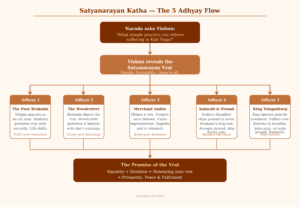
Adhyay 2 — The Poor Brahmin and the Woodcutter
The second chapter continues the Brahmin’s story and introduces a new character — a woodcutter who crosses his path.
The Brahmin has now been performing the Satyanarayan Vrat regularly, and his life has genuinely improved. He is no longer struggling in the same desperate way. One day, while going about his work, he encounters a woodcutter — a simple man who earns his living by cutting and selling wood, tired from a long morning of work.
The woodcutter sees the Brahmin returning from what appears to be a puja and asks him about it — what is this ritual, and why does he do it? The Brahmin explains the Satyanarayan Vrat warmly and without condescension. He tells the woodcutter what it involves, why he started it, and what it has meant for his family.
The woodcutter listens carefully. He is not a learned man. He does not know Sanskrit, does not have a pandit at hand, and has very modest means. But something in what the Brahmin says reaches him. He decides that on the day he sells his wood, whatever he earns, he will use a portion of it to perform the puja.
That day he goes to the market, sells his wood, and earns more than he expected. He uses part of it to gather the puja items — simple, affordable, genuine. He goes home, gathers his family, and performs the Satyanarayan Puja with complete devotion. From that point, the woodcutter’s life too begins to change — not dramatically overnight, but in the steady, quiet way that devotion tends to work.
Moral: Faith and humility are the only real requirements. This vrat belongs to anyone who performs it with an honest heart, regardless of their background or learning.
Adhyay 3 — The Merchant Sadhu and the Broken Promise
The third chapter is where the katha shifts in tone. Up to this point, the stories have shown what happens when the vrat is kept. This chapter shows what happens when a vow is made and then forgotten.
A wealthy merchant named Sadhu is travelling by boat when a storm forces him to take shelter. There, he encounters a group of people performing the Satyanarayan Puja. He joins them respectfully, listens to the katha, and in the midst of it — moved by the ritual and by his own circumstances — makes a vow. He promises Lord Vishnu that if he is blessed with a child and his journey is completed safely, he will perform the Satyanarayan Puja upon returning home.
Both wishes are fulfilled. He returns home safely. His wife gives birth to a daughter, whom they name Kalavati. Life goes on, and Sadhu prospers. But the vow he made on that stormy night? It drifts to the back of his mind. Days pass. Months pass. He keeps meaning to organise the puja, but there is always something more pressing.
Lord Vishnu does not forget a vow even when the person who made it does. On one of Sadhu’s subsequent trading journeys, things begin to go wrong in ways he cannot explain. He is detained by a king on false charges and imprisoned. Back home, his family faces difficulty. Nothing seems to resolve, no matter what he tries.
It is only in prison, with time to reflect, that Sadhu connects what has happened to the promise he made and abandoned. He repents sincerely and vows again — this time to perform the puja the moment he is free. Almost immediately, circumstances shift. He is released. He returns home and this time, without delay, he performs the Satyanarayan Puja as he had promised.
Moral: A vow made to the Lord is not a formality. It is a commitment with real weight. The consequence of forgetting it is not divine punishment in a punitive sense — it is simply the natural result of living out of alignment with what you yourself declared to be true.
Adhyay 4 — Kalavati and the Importance of Prasad
The fourth chapter follows Sadhu’s daughter Kalavati into her own life — and tells one of the most striking stories in the entire katha.
Kalavati grows up, marries, and her husband becomes a trader. He sets out on a sea voyage for business, promising to return. The journey is long, and Kalavati waits. One evening, a Satyanarayan Puja is being performed in her neighbourhood. Kalavati attends — but when the prasad is distributed at the end, she does not take it. She is in a hurry to return home and check whether her husband has sent news. She leaves without accepting or eating the prasad.
That night, news arrives that her husband’s ship has been caught in a violent storm at sea. The ship is lost. The crew is missing. Kalavati is devastated.
Her father Sadhu, now experienced in the ways of this vrat, understands what may have happened. He advises Kalavati to go back to the puja, accept the prasad she declined, and do so with full sincerity and reverence. Kalavati does exactly that — she returns, receives the prasad properly, and prays with complete devotion.
Shortly after, news comes that her husband’s ship has been found. He is alive and safe and making his way home.
Moral: Prasad is not a formality to be skipped on the way out. It is the physical conclusion of an act of devotion — the moment when the Lord’s blessing is received into the body. Receiving it carelessly, or not at all, is not a minor thing. How we receive prasad reflects how we have received the entire ritual.
Adhyay 5 — King Tungadhwaj’s Pride
The fifth and final chapter moves away from ordinary people and into a royal court — and in doing so, makes the point that the status of the devotee changes nothing about what the vrat requires.
King Tungadhwaj is out hunting in the forest when he comes across a group of cowherds performing the Satyanarayan Puja under a tree. It is a simple, humble affair — no grand decorations, no elaborate setup. Just people gathered in devotion with what they have.
The king observes this from a distance. He does not dismount from his horse. He does not greet them or join them. In fact, he barely acknowledges what is happening. In his mind, perhaps, a king does not stop for a puja performed by cowherds in the forest. He rides on.
What follows is a series of misfortunes that accumulate with an almost quiet relentlessness. His kingdom begins to face difficulties. His family is affected. His cattle suffer losses. Nothing terrible and sudden — but a steady erosion of what he had taken for granted.
It takes time, but eventually the king understands that his suffering connects to the moment in the forest when he chose pride over reverence. He returns to the spot, finds the cowherds, and this time participates in the puja fully — with humility, with sincerity, and with the prasad accepted and eaten. His circumstances slowly restore themselves.
Moral: Pride is the one obstacle that status cannot remove. The divine does not distinguish between a king and a woodcutter. What it recognises is the quality of attention brought to the moment.
What Each Chapter Teaches Modern Readers
Taken together, the five adhyays form a complete picture of how to approach this vrat — and, in a broader sense, how to approach life’s commitments and blessings:
- Keep your promises. Sadhu’s story (Adhyay 3) is a clear reminder: a vow made with sincerity, even in a difficult moment, cannot simply be set aside when life improves. Intentions matter, and they carry weight.
- Share your blessings. The Brahmin in Adhyay 2 does not keep his discovery of the vrat to himself. He explains it warmly to the woodcutter. The sharing of good things — knowledge, prasad, practice — is woven into the spirit of the puja.
- Respect the ritual. Kalavati’s story (Adhyay 4) is specifically about what happens when we treat the final act of a ritual as optional. Every part of the puja — including the prasad — exists for a reason.
- Stay humble. King Tungadhwaj (Adhyay 5) is perhaps the most relatable character in the katha for a modern reader. Many of us have walked past something simple and meaningful because it did not look important enough. The chapter asks us to reconsider that instinct.
- Have faith. The woodcutter in Adhyay 2 had no expertise, no guidance, and no grand resources. What he had was the willingness to try. That, the katha says, is enough.
When the Katha is Recited During the Puja
The katha is not background music. It is the central act of the puja.
- It is recited after the main ritual worship — typically at Step 13 of the full vidhi, once all the offerings have been made and the deity has been invoked
- All family members and guests present are expected to sit and listen for the full duration — not to move around, check their phones, or step out
- After each adhyay, it is traditional to offer a coconut as a mark of reverence before the next chapter begins
- The katha can be recited by the pandit, by a family member who knows it well, or read aloud from a printed text
- For families hosting the puja in a language other than Hindi — Marathi, Gujarati, Bengali, Kannada, Tamil — the katha is widely available in all these languages, and pandits typically use the version the hosts are most comfortable following
→ For the complete step-by-step sequence: Satyanarayan Puja Vidhi →
Frequently Asked Questions
How many adhyays are in the Satyanarayan Katha? The standard katha has five adhyays. Some Bengali traditions follow a seven-adhyay version, which includes two additional chapters recounting the later rebirths of characters from the original story. The five-adhyay version is the one followed across most of India.
What does ‘adhyay’ mean? Adhyay is a Sanskrit word meaning chapter or section. In the context of the katha, each adhyay is a self-contained story that illustrates a different aspect of the Satyanarayan Vrat.
Can the katha be read in any language? Yes. The katha exists in Hindi, Marathi, Bengali, Gujarati, Tamil, Kannada, Telugu, and English, among others. Pandits typically use the version that the family hosting the puja is most comfortable following along with. There is no rule that it must be in Sanskrit or Hindi.
Is it okay to listen to the katha on YouTube instead of having a pandit read it? During the puja itself, the tradition is for a person to recite the katha — ideally a pandit, or a family member who knows it well. Outside of the puja context, listening to the katha on YouTube or audio is perfectly fine and is considered a form of shravan — sacred listening — which carries its own spiritual merit.
What is the 6th and 7th adhyay? The standard Satyanarayan Katha has five adhyays. Some Bengali editions include two additional chapters that follow the characters from the original katha through later events and rebirths. These are not part of the five-adhyay version used in most puja traditions across India.